
Section 01 · Definition
What is a do-while loop in Solidity?
A do-while loop runs its body before evaluating the condition. The condition appears at the bottom of the construct, after the closing brace, followed by a semicolon.
Quick answer
In one sentence: A Solidity do-while loop always executes its body at least once, then repeats as long as the condition at the bottom remains true — making it the right choice when one execution is required before the exit test is meaningful.
The syntax places do before the opening brace and the while (condition) clause after the closing brace. The trailing semicolon is required and is a common source of compile errors when switching from a regular while to a do-while.
// Example 1 — runs at least once, even if condition is false from the start
uint256 i = 0;
do {
    i++; // body always executes here first
} while (i < 5);
// i = 5 after the loop

// Example 2 — find the next free parking spot starting from a hint
bool[10] memory occupied; // 10 parking spots
uint256 hint = 3; // start checking from spot 3
uint256 spot = hint;
do {
    if (!occupied[spot]) {
        break; // found a free spot
    }
    spot++;
} while (spot < 10);
// spot is now the first free spot >= hint
That last point matters for correctness: if arr.length is zero, a while loop would never enter the body, but a do-while executes it once regardless. Accessing arr[i] inside that body on an empty array is an out-of-bounds access. Always guard against empty arrays before entering a do-while loop if the body reads from an array.
Section 02 · Comparison
do-while vs while: the one key difference
Both loops compile to equivalent EVM bytecode for the same logic. The only semantic difference is where the condition is evaluated.
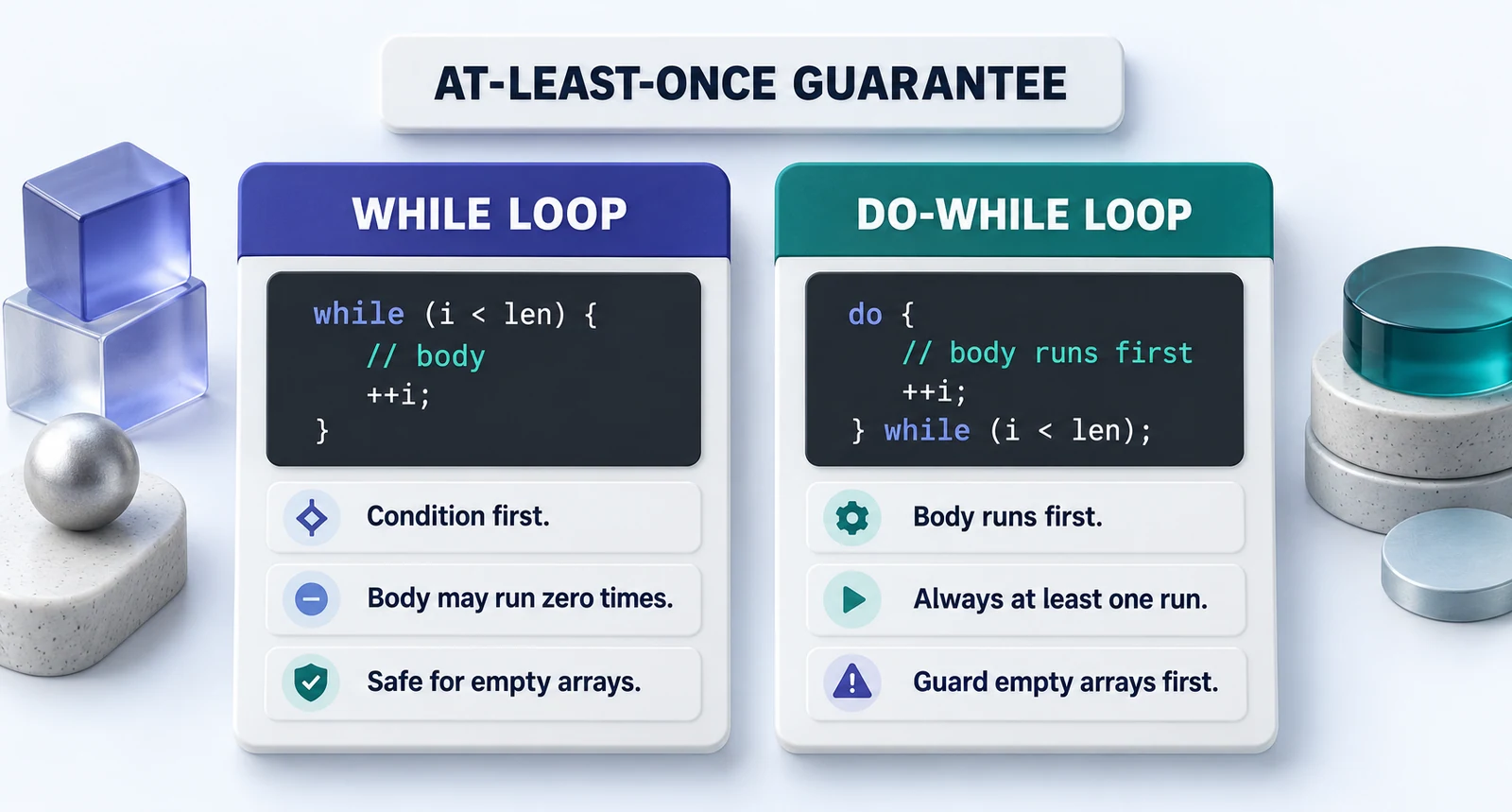
while: condition checked before the first run
If the condition is false when the loop is first reached, the body never executes. This is the correct choice when zero iterations is a valid outcome, for example iterating over an array that may be empty.
do-while: body runs before the first check
The body always executes at least once regardless of the condition value. Use this when one execution is required before it makes sense to test the exit condition — for example, reading the current slot before deciding whether to advance to the next.
Gas and bytecode are equivalent
The Solidity compiler rewrites both forms to the same JUMPI instruction sequence. There is no gas cost difference between an equivalent while and do-while. The choice is about semantics and readability, not gas.
Section 03 · Canonical pattern
Slot scanning: the classic do-while use case
Finding the next available slot in a packed bitmap or array is the most common on-chain use for do-while. You must read the current position before you can decide whether to advance.
// 100 seats in a venue: true = taken, false = free
bool[100] public seatTaken;

/// Find the next free seat starting from a caller-supplied hint.
/// The do-while checks the hint seat first, then scans forward.
function nextFreeSeat(uint256 hint) public view returns (uint256 seat) {
    require(hint < 100, "hint out of range");
    seat = hint;
    do {
        if (!seatTaken[seat]) return seat; // found a free seat
        unchecked { ++seat; }
    } while (seat < 100);
    revert("no free seats from hint onward");
}
The do-while is natural here because the hint position itself must be checked before the loop decides to advance. A while loop would require duplicating the check before the loop or restructuring the body, making the code harder to read. With do-while the intent is direct: inspect the current slot, move forward if occupied, stop when a free slot is found or the array is exhausted.
The hint-based slot scan is O(n) worst case
If every slot from hint to the end is occupied, the loop runs (256 - hint) iterations. For a production contract, combine this with an off-chain hint passed by the caller so the on-chain scan is typically O(1) amortized. The MAX_SLOTS constant keeps the worst case bounded even if the caller passes a bad hint.
Section 04 · Full contract
Complete example: EventSeating smart contract
A concert hall booking contract with 100 numbered seats. Attendees suggest a preferred seat number; the do-while loop checks that seat first, then scans forward if it is taken. This is the exact scenario where do-while shines — the hint seat must be inspected before deciding to move on. Deploy on Remix and book seats from different accounts.
// SPDX-License-Identifier: MIT
pragma solidity ^0.8.24;

/// @title EventSeating
/// @notice Concert hall with 100 numbered seats.
///         Attendees pay to book a seat; they suggest a preferred
///         seat number and the do-while loop finds the closest
///         available seat from that hint onward.
contract EventSeating {

    // ── Constants ────────────────────────────────────────────────────
    uint256 public constant TOTAL_SEATS  = 100;
    uint256 public constant TICKET_PRICE = 0.01 ether;

    // ── State ────────────────────────────────────────────────────────
    address public owner;

    struct Seat {
        address holder;     // who booked this seat
        uint64  bookedAt;   // block.timestamp at booking
        bool    taken;
    }

    mapping(uint256 => Seat) public seats;   // seat index => Seat
    uint256 public seatsSold;

    // ── Events ───────────────────────────────────────────────────────
    event SeatBooked(address indexed attendee, uint256 seatNumber, uint256 paid);
    event SeatCancelled(address indexed attendee, uint256 seatNumber);
    event Withdrawn(address indexed owner, uint256 amount);

    // ── Modifiers ────────────────────────────────────────────────────
    modifier onlyOwner() {
        require(msg.sender == owner, "not owner");
        _;
    }

    constructor() {
        owner = msg.sender;
    }

    // ── Write ────────────────────────────────────────────────────────

    /// @notice Book a seat starting from a preferred seat number.
    ///         If the preferred seat is taken, the do-while scans forward
    ///         until it finds the next free one.
    /// @param  preferredSeat  The seat number the attendee wants (0-99).
    /// @return bookedSeat     The actual seat number that was booked.
    function bookSeat(uint256 preferredSeat)
        external payable
        returns (uint256 bookedSeat)
    {
        require(msg.value == TICKET_PRICE, "wrong ticket price");
        require(seatsSold < TOTAL_SEATS,   "event fully booked");
        require(preferredSeat < TOTAL_SEATS, "seat out of range");

        // ── do-while: check the preferred seat first, then scan forward ──
        bookedSeat = preferredSeat;
        do {
            if (!seats[bookedSeat].taken) {
                // Found a free seat — book it immediately.
                seats[bookedSeat] = Seat({
                    holder:   msg.sender,
                    bookedAt: uint64(block.timestamp),
                    taken:    true
                });
                unchecked { ++seatsSold; }
                emit SeatBooked(msg.sender, bookedSeat, msg.value);
                return bookedSeat;
            }
            unchecked { ++bookedSeat; }
        } while (bookedSeat < TOTAL_SEATS);
        // ────────────────────────────────────────────────────────────────

        // All seats from preferredSeat to 99 are taken.
        // Try from seat 0 up to preferredSeat - 1.
        bookedSeat = 0;
        do {
            if (!seats[bookedSeat].taken) {
                seats[bookedSeat] = Seat({
                    holder:   msg.sender,
                    bookedAt: uint64(block.timestamp),
                    taken:    true
                });
                unchecked { ++seatsSold; }
                emit SeatBooked(msg.sender, bookedSeat, msg.value);
                return bookedSeat;
            }
            unchecked { ++bookedSeat; }
        } while (bookedSeat < preferredSeat);

        revert("no free seat found"); // unreachable given seatsSold guard
    }

    /// @notice Cancel your booking and receive a refund.
    function cancelSeat(uint256 _seatNumber) external {
        require(_seatNumber < TOTAL_SEATS, "seat out of range");
        Seat storage s = seats[_seatNumber];
        require(s.taken,            "seat not booked");
        require(s.holder == msg.sender, "not your seat");

        delete seats[_seatNumber];
        unchecked { --seatsSold; }
        emit SeatCancelled(msg.sender, _seatNumber);

        (bool ok,) = msg.sender.call{value: TICKET_PRICE}("");
        require(ok, "refund failed");
    }

    // ── Read ─────────────────────────────────────────────────────────

    /// Check whether a specific seat is free.
    function isFree(uint256 _seatNumber) external view returns (bool) {
        require(_seatNumber < TOTAL_SEATS, "seat out of range");
        return !seats[_seatNumber].taken;
    }

    /// Return how many seats are still available.
    function seatsAvailable() external view returns (uint256) {
        return TOTAL_SEATS - seatsSold;
    }

    /// Return the holder of a seat, or address(0) if free.
    function seatHolder(uint256 _seatNumber) external view returns (address) {
        require(_seatNumber < TOTAL_SEATS, "seat out of range");
        return seats[_seatNumber].holder;
    }

    // ── Admin ────────────────────────────────────────────────────────

    /// Withdraw ticket revenue (owner only).
    function withdraw() external onlyOwner {
        uint256 bal = address(this).balance;
        require(bal > 0, "nothing to withdraw");
        (bool ok,) = owner.call{value: bal}("");
        require(ok, "withdraw failed");
        emit Withdrawn(owner, bal);
    }
}
To test in Remix: deploy the contract, then call bookSeat(5) with 0.01 ETH — it books seat 5. Call it again with the same hint from a different account — seat 5 is taken, so the do-while loop scans to seat 6 and books that. Call seatsAvailable() to confirm the count drops with each booking.
Section 05 · Common mistakes
Four do-while mistakes to avoid
do-while shares all the risks of while loops and adds one unique trap: the guaranteed first execution that runs even when it should not.
Forgetting the trailing semicolon
do { ... } while (condition) requires a semicolon after the closing parenthesis. Omitting it is a compile error. This trips up developers who are used to while loops, where there is no trailing semicolon. The Solidity compiler error message is typically 'Expected semicolon after do-while statement'.
Accessing array elements without a length guard
The do-while body always executes at least once. If the body reads arr[i] and arr is empty, that is an out-of-bounds access that reverts. Always add require(arr.length > 0) or an equivalent guard before a do-while that reads array elements inside the body.
Using do-while when zero iterations is valid
If the task is simply 'iterate over a list that may be empty', a while or for loop is correct. Using do-while forces at least one iteration, which is a semantic error when the list is empty. Reserve do-while for cases where one execution is genuinely required before the condition is meaningful.
Infinite loop from a non-advancing condition variable
Identical to the while loop risk: if the variable checked in the condition is never modified inside the body, the loop runs forever. In a do-while this is especially subtle because the first iteration succeeds before you notice the condition is stuck. Every do-while body must make progress toward a false condition on every code path.