Quick answer
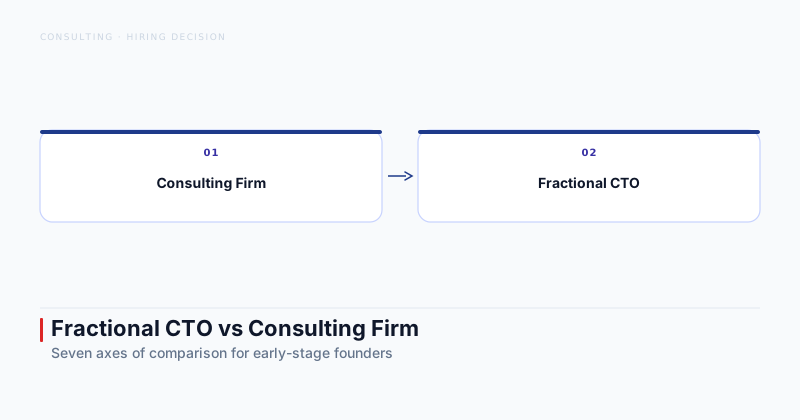
What is the difference between a fractional CTO and a consulting firm? A consulting firm provides scoped deliverables billed at hourly or project rates through a staffed team. A fractional CTO embeds as a part time technology leader on a monthly retainer, making architectural decisions, setting the roadmap, and hiring engineers — with accountability for outcomes, not just outputs. The models differ fundamentally in continuity, seniority mix, IP ownership, and what happens when the engagement ends.
Model 1
What a consulting firm actually delivers
Understanding what you are paying for before you sign the statement of work.
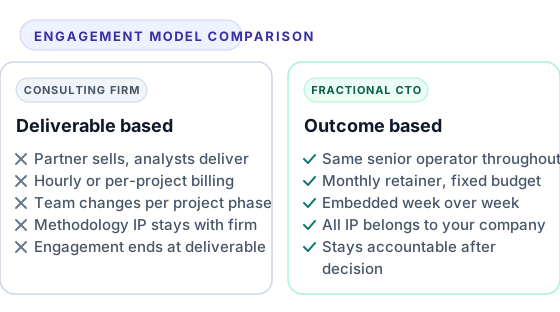
A consulting firm is a professional services organization. You engage it to solve a defined problem within a defined scope, and it delivers an output — a strategy document, a technical assessment, a process redesign, a readiness report. The deliverable is the product. When the deliverable is done, so is the engagement.
The staffing model follows the deliverable model. A senior partner or principal closes the sale and defines the approach. An engagement manager runs the project. Associates and analysts do the research, the interviews, the slide decks, and the code. You see the partner at kickoff and at the final readout. The people doing the work are early in their careers.
Billing is typically hourly or per project. Large firms charge $300 to $800 per hour blended across their team, which means you pay for analyst hours at partner rates when the contract is written as a lump sum. Boutique or specialist firms are cheaper but follow the same model: a scoped piece of work, a fixed fee, a final deliverable.
The firm retains ownership of its methodologies, frameworks, and playbooks. The deliverable you receive — the report, the deck, the audit findings — is yours. The intellectual property embedded in how they produced it is theirs. This matters when you want to repeat the analysis in a year: you will need to hire them again.
Knowledge transfer at the end of a consulting engagement is notoriously shallow. The exit is a final presentation and a document handoff. The understanding of why the recommendations were made, and the nuance behind the tradeoffs, walks out the door with the team.
Model 2
What a fractional CTO actually does
Not a consultant with a fancier title — a different operating model entirely.
A fractional CTO is a senior technology leader who works part time inside your company — typically two to three days per week — on a monthly retainer. The key word is inside. They are not an external vendor delivering a report. They attend your sprint reviews, join your founder calls, interview your engineering candidates, and write the architecture decision records your team will reference for years.
The scope is not bounded by a deliverable. A fractional CTO owns the technology strategy for as long as the engagement runs. That means setting the roadmap, making architectural decisions, evaluating vendors, hiring engineers, and giving your board a credible technical voice. When something breaks in production at 11 p.m., you call them — not a firm.
Seniority is not diluted. You are hiring the person, not the firm. The fractional CTO who closes your agreement is the same person who shows up every week. There is no staffing switch after the kickoff.
Everything produced during the engagement belongs to your company. Code, architecture decision records, runbooks, vendor evaluations, hiring rubrics, and technical documentation are all work product owned by you. When the engagement ends, the knowledge stays.
Rates typically run $8,000 to $20,000 per month for two to three days per week of senior time — a fraction of what a full time CTO costs in salary, benefits, and equity, and a fraction of what a senior consulting team costs for a comparable scope of work over the same period.
The Comparison
Seven axes where the models diverge
Put the two models side by side and the differences are structural, not stylistic.
Founders often treat these as interchangeable options for the same problem. They are not. The differences below are not matters of degree — they are differences in operating logic.
| Axis | Consulting Firm | Fractional CTO |
|---|---|---|
| Accountability model | Deliverable based — you receive a report, deck, or plan. Accountability ends when the document is delivered. | Outcome based — the same person stays accountable for whether the architecture ships, the team hires correctly, and the roadmap executes. |
| Seniority mix | Partner sells, analysts deliver. The senior judgment you bought is rarely the person doing the work. | One senior operator throughout. The person you hired is the person in every meeting. |
| Billing model | Hourly or per project. Blended rates mask analyst hours billed at senior rates. | Monthly retainer. Fixed budget, predictable cost. |
| Staffing continuity | Team composition changes per project phase. New faces after the kickoff are common. | Same person embedded week over week across the full engagement. |
| IP ownership | Methodology belongs to the firm. Deliverable is yours. Frameworks cannot be reused without re-engaging the firm. | All work product — code, docs, runbooks, decision records — belongs to your company from day one. |
| Decision making pace | Structured review cycles — weekly or biweekly check-ins and a final readout. Decisions route through the firm's internal process. | Available weekly, often reachable async daily. Decisions happen when your team needs them. |
| Exit and knowledge transfer | Final presentation and document handoff. The understanding of why decisions were made leaves with the team. | Living documentation, trained team, and a structured transition plan. The knowledge stays inside the company. |
The accountability gap is the most expensive difference
A consulting firm is accountable for producing the deliverable, not for what happens after you implement it. A fractional CTO who recommends an architecture decision has to live with it — because they are still in the building three months later when the consequences show up. That skin in the game changes the quality of the advice.
Honest Assessment
When a consulting firm is the right answer
There are real scenarios where a consulting firm is the correct tool. Knowing them keeps you from misapplying either model.
A fractional CTO is not the right answer for every problem. Three scenarios reliably favor the consulting firm model.
M&A technical due diligence requiring a credentialed firm
When a buyer or investor requires technical due diligence from a known firm — because their legal process mandates an approved vendor list, because the report will be cited in a regulatory filing, or because the acquiring board requires a brand they recognize — a consulting firm is what the process demands. A fractional CTO, however senior, cannot satisfy that requirement.
One-off compliance audits with approved vendor requirements
SOC 2 readiness assessments, ISO 27001 gap analyses, and HIPAA security reviews often require an auditor from an approved vendor list. The approval process is institutional, not competency based. If your customer or regulator requires a specific type of firm, hire that type of firm.
Board level reporting that needs a third party signature
Some boards and investors require that strategic technology assessments carry the weight of an external firm rather than internal judgment. If the specific requirement is a named firm's brand on the cover page — not senior technical judgment — a consulting firm is what is being requested.
Outside these three scenarios, the consulting firm model typically costs more, delivers shallower judgment, and leaves you without a senior operator when the engagement ends. It is the right tool for bounded, credential-requiring problems. It is not a substitute for ongoing architectural leadership.
Fit Analysis
When to hire a fractional CTO instead
The scenarios where ongoing embedded judgment outperforms a scoped deliverable.
Most early stage startups evaluating a consulting engagement for technology strategy are actually describing a fractional CTO problem. Four signals indicate this clearly.
You need a decision maker, not a report
If your core need is someone who picks the cloud provider, chooses the AI stack, designs the data architecture, and then stays accountable for whether those decisions hold up six months later — that is a fractional CTO role. A consulting firm will give you a recommendation and leave. The fractional CTO makes the call and stays to see it through.
You are evaluating vendors across a multi-month window
Evaluating AI vendors, engineering agencies, or platform providers is not a one-week project. It requires understanding your stack deeply, running proof of concepts, negotiating contracts, and checking references over time. A fractional CTO who is embedded in your company brings consistent context to every vendor conversation. A consulting firm brings a fresh team every time the scope changes.
Your technical decisions compound over time
Technology choices made in month one constrain what you can build in month six. A fractional CTO who made those choices in month one understands exactly why they were made and what the tradeoffs were. A consulting firm brought in at month six starts from scratch and produces a report that may contradict the earlier decisions without understanding why they were correct at the time.
You are filling a senior technology gap, not buying a deliverable
Founders leading the technology function alone, companies between CTOs, and teams where engineering decisions need a senior voice — these are continuity problems, not project problems. The solution is an embedded operator with ongoing accountability, not a scoped engagement that ends before the gap is closed.
For more on how to think through the hiring decision, see the fractional CTO hiring guide and the comparison between a fractional CTO and a technical cofounder.
Due Diligence
Four questions to ask before you sign either engagement
The answers to these questions will tell you more than the firm's marketing page.
Who is the actual person doing our work, and what is their background?
In a consulting engagement, the honest answer is often not the partner who presented to you. Ask for the names and LinkedIn profiles of the people who will be in your weekly calls. In a fractional CTO engagement, the answer should always be the person sitting across from you right now.
When the engagement ends, who owns the code, the documentation, and the institutional knowledge?
Get this in writing before you sign. Consulting firms sometimes include language that licenses — rather than assigns — the deliverables to you, or retains rights to methodology embedded in any code produced. A fractional CTO engagement should assign all work product to your company with no carve-outs.
What does success look like at six months, and who is accountable if we fall short?
A consulting firm will define success as delivery of the agreed scope. A fractional CTO should be willing to define success as a business outcome — the architecture shipped, the team hired, the vendor selected and integrated. If the person across from you cannot answer this question with specifics, keep looking.
How quickly can we reach you when a production decision needs to be made at 11 p.m.?
A consulting firm operates on structured review cycles. After hours contact is not part of the model. A fractional CTO who is genuinely embedded in your company should be reachable for production emergencies, architectural forks, and urgent decisions — not as the expectation every night, but as the reality when it matters.
If you are evaluating an external technology vendor alongside a fractional CTO, see the guide to evaluating an AI consulting proposal and the comparison between hiring an AI engineer versus an AI consultant.
The Gray Zone
Where the two models can work together
They are not always mutually exclusive — but the sequencing matters.
Some companies use both. The sequence that works is: fractional CTO first, consulting firm when a specific credential is required. The fractional CTO builds the institutional knowledge and sets the strategy. When a specific audit, a regulated due diligence process, or a board-mandated third party review is required, the consulting firm is engaged for that bounded scope — with the fractional CTO managing the engagement and translating the findings back into the technology roadmap.
The sequence that does not work is the reverse: consulting firm first for the strategy, then a fractional CTO to implement. The fractional CTO inherits a strategy built without institutional knowledge of your company, must either follow recommendations they did not make or spend their first months undoing them, and lacks the context to explain why earlier decisions were correct. You pay twice for the thinking.
The fractional CTO manages the consulting engagement — not the other way around
If you have a fractional CTO and also need a consulting firm for a specific deliverable, let the fractional CTO scope, manage, and translate the consulting engagement. They have the institutional context to make the consulting firm productive and to protect you from recommendations that look good in a deck but do not survive contact with your actual stack.
For context on how this compares to the AI agency model — which is a third option many founders consider — see the comparison between a fractional CTO and an AI agency.