Section 01 · Definition
What an enterprise AI strategy has to settle
Most enterprise AI strategies fail by being a vision with no decisions in it. A useful one settles a short list of questions in writing.
Quick answer
What is an enterprise AI strategy? An enterprise AI strategy turns scattered experiments into a governed portfolio tied to measurable business outcomes. It sets use case priorities, data needs, ownership, governance, build versus buy choices, and adoption measures, then defines how pilots reach dependable production without duplicated systems or unmanaged risk.
An enterprise AI strategy is the set of decisions that tells an organization where AI will be used, why, who owns it, what it runs on, and how anyone will know it worked. Microsoft frames AI strategy as a coordinated plan tied to organizational goals, and lists executive alignment, use case prioritization, data and infrastructure, talent, governance, and return metrics as its core components.
IBM makes a related point from the capability side: enterprise AI combines technology, processes, and people, so a strategy that covers only the technology is incomplete by definition.
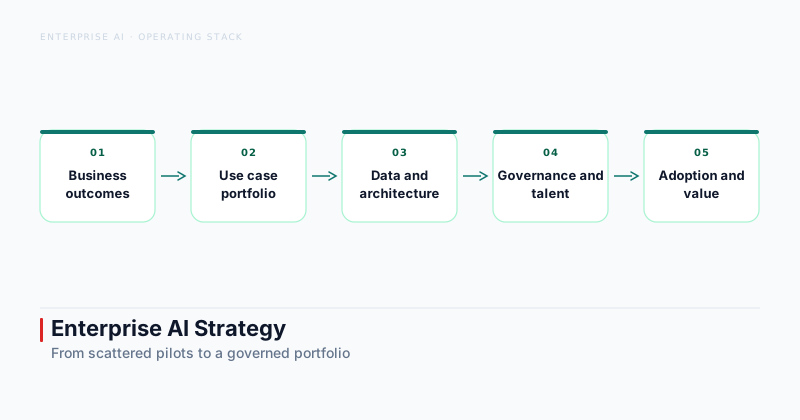
I write these for CTOs and founders who already have pilots running. The pattern I see most is a roadmap of initiatives with no shared rules for how an initiative earns production status. The rest of this framework fixes that. It follows six decisions in the order they constrain each other: outcomes, portfolio, data and integration, governance, sourcing, and measurement.
A strategy is also not the same thing as a roadmap. A roadmap sequences initiatives. The strategy explains why those initiatives matter, who decides, what governance applies, and how value gets measured. The roadmap is one artifact inside it.
Section 02 · Decision 1
Define enterprise outcomes before selecting technology
Start from the business result you want to move, then work backward to the technology. The reverse order produces impressive demos with no owner.
Every use case in the strategy should connect to one measurable business goal. Reduced handling time in a support queue, faster contract review, fewer manual reconciliations, lower cost per resolved ticket: each is a number somebody already tracks. If the only success statement is that the model works, the use case is not ready for the portfolio.
Tie each use case to a measurable business goal
Write the goal as a baseline, a target, and an owner. The owner is a business leader who controls the process the AI changes, not the engineer who built the prototype. When the owner will not sign the target, you have learned something important before spending the budget.
Separate strategic priorities from opportunistic experiments
Experiments are healthy. Teams learn what models can do by trying things, and a strategy that bans exploration will push it underground. The discipline is labeling. Strategic priorities get funding, owners, and production criteria. Opportunistic experiments get a small, time boxed budget and an explicit expiry. Nothing moves from the second bucket to the first without passing the same gate as everything else.
This also protects your engineering capacity. A team that treats every promising demo as a commitment will end up maintaining a dozen half owned systems, which is the fastest route to a stalled program.
Section 03 · Decision 2
Build a portfolio instead of isolated pilots
Isolated pilots compete for the same data, the same engineers, and the same executive attention. A portfolio makes the trade offs visible.
Microsoft states that disconnected AI projects commonly create duplicated effort, missed opportunities, stalled pilots, and fragmented spending. That matches what I see in client reviews: two teams buying the same capability under different budgets, three prototypes built on three different retrieval stacks, and no one able to say which one should survive.
Box describes enterprise AI strategy as an organization wide plan that covers business problems, data foundation, governance, production architecture, workforce, change management, ownership, sequencing, and KPIs. The useful word in that description is sequencing. A portfolio is an ordered set of bets, not a list.
Prioritize value and feasibility
Score each candidate on business value and on feasibility, and keep the scoring honest by splitting feasibility into its real parts: data readiness, integration complexity, risk, adoption friction, and operating cost. A use case with high value and low feasibility is a data or platform investment in disguise. Name it that way, and fund the enabling work first. If you want a structured way to assess the starting position, the AI readiness assessment framework covers the questions to ask before scoring begins.
Create a path from pilot to production
Most pilot programs have a start gate and no finish gate. Define the finish gate once and apply it everywhere. The table below is the acceptance criteria I use to decide whether a pilot graduates, extends, or stops.
| Gate | Question to answer | Evidence required |
|---|---|---|
| Value | Which business metric moves, and by how much? | Named owner, baseline, and target |
| Data | Can the system read the data it needs under the right permissions? | Source inventory, access path, and a quality check |
| Integration | Does it run inside the real workflow and systems? | Integration plan agreed with the system owner |
| Risk | What happens when the output is wrong? | Failure modes, human review points, and security review |
| Operations | Who runs it after launch? | Named on call owner, monitoring, and a cost ceiling |
| Adoption | Will the intended users change how they work? | Training plan and a usage target |
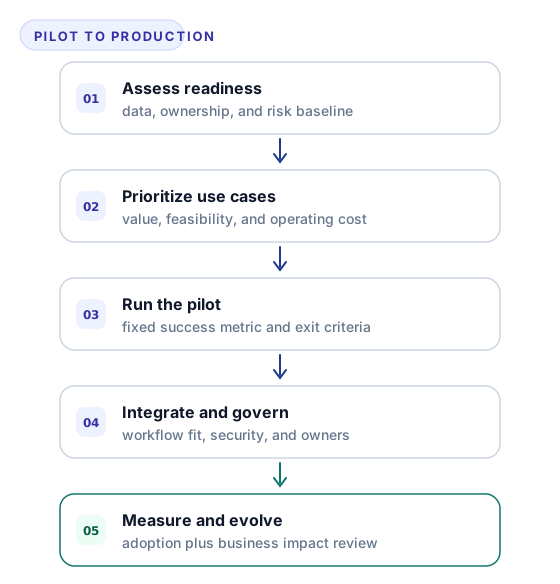
A pilot that cannot fill in the Operations row is not blocked by technology. It is blocked by ownership, and no amount of model tuning will fix that.
Section 04 · Decision 3
Treat data, integration, and reliability as strategy inputs
The model is the easy part to swap. Data access, integration, and reliability decide whether anything reaches production.
IBM describes enterprise AI as a business capability that requires data quality, governance, security, compliance, and integration with existing systems to deliver value at scale. Read that list as a set of constraints on your portfolio, because each one can disqualify a use case that looked attractive on value alone.
Map data quality and access constraints
For each prioritized use case, list the data it needs, where that data lives, who owns it, and what permissions apply. Then check the uncomfortable cases: data spread across systems with different identity models, documents with inconsistent ownership, and sources that look complete but have not been maintained. Findings here change the sequence of your roadmap. A use case that depends on a data source nobody owns moves down the list until someone does.
Design for existing workflows and enterprise systems
AI that lives in a separate tool asks users to change habits, and most will not. Put the capability where the work already happens: the ticketing system, the CRM, the document platform, the internal portal. That means integration work with the owners of those systems, so those owners belong in the planning, not in the handoff.
Reliability needs the same treatment. Decide up front what the system does when a model call fails, when output quality drops, or when cost spikes. Production behavior depends on tracing and measurement, which is why I treat LLM observability as part of the platform decision rather than an afterthought.
Section 05 · Decision 4
Design governance and ownership before scaling
Governance added after scale is a retrofit. Governance designed first is a template that every new use case inherits.
Microsoft's enterprise adoption guidance says organizations that scale successfully establish governance early, invest in data readiness, build cross functional teams, and prioritize workforce enablement. I would add one practical observation: the early governance that works is small. A one page intake process, a named risk reviewer, and a standard set of checks beat a large policy document nobody reads.
Cross functional oversight and accountability
AI programs touch engineering, security, legal, data, operations, and the business units that own the process. Give the program a standing group with those voices, a decision log, and clear rules for who can approve a use case, who can pause one, and who is accountable when something goes wrong. Without that, every decision becomes a negotiation, and every incident becomes an argument about whose problem it was.
Security, compliance, and confidence from the start
Build security review and compliance checks into the same acceptance criteria shown earlier, so they are part of how a pilot graduates rather than a surprise at the end. For deeper treatment of controls on production language model systems, see the AI governance framework for production LLMs.
Ownership has a talent side too. Someone has to hold the architecture across projects, or each team will make locally sensible choices that do not fit together. In smaller organizations that is often a fractional or external role. The AI systems architect role explains what that person is accountable for.
Section 06 · Decision 5
Make build, buy, and partner choices deliberately
Sourcing decisions made one project at a time create lock in nobody chose. Make them as strategy decisions.
Microsoft recommends choosing among build, buy, and partner by weighing cost, speed, control, and strategic differentiation, and keeping contracts and architectures flexible to reduce lock in. The second half of that advice is the one teams skip. A buy decision that is cheap to make and expensive to reverse is a commitment, whatever the procurement paperwork says.
| Choice | Pick it when | Watch for |
|---|---|---|
| Build | The capability differentiates you and you hold proprietary data | Ongoing ownership, scarce talent, and maintenance cost |
| Buy | The capability is common and speed matters most | Data handling terms, lock in, and usage fees that scale with success |
| Partner | You need expertise or capacity you cannot hire quickly | Knowledge that leaves with the partner, and weak exit terms |
Keep differentiating capabilities close
Build or tightly control the parts that encode your advantage: your data, your evaluation criteria, and your domain logic. Commodity layers are usually better rented. The build versus buy AI decision framework goes through the scoring in detail.
Use flexible contracts and architectures
Separate the model layer from your application logic so that changing a provider is a configuration project, not a rewrite. Keep your prompts, evaluation sets, and data pipelines in assets you own. Negotiate contract terms around data use, portability, and exit before you are dependent, because your negotiating position is strongest at the start.
Section 07 · Decision 6
Measure adoption and business impact together
Usage tells you people showed up. Impact tells you it mattered. You need both, and you need to read them side by side.
Microsoft's enterprise adoption guidance recommends tracking both adoption and business impact metrics, and treats AI adoption as an ongoing cycle of learning, optimization, and governance. That framing matters because a strategy is never finished. Models change, costs change, and business priorities move.
Track usage plus outcome metrics
Pair every adoption number with an outcome number. High usage and flat outcomes usually mean the tool is convenient but not changing the work, or the metric is wrong. Strong outcomes and low usage usually mean a small group is getting value that the rest of the organization cannot reach, which is an enablement and workflow problem. Cost belongs on the same dashboard. An outcome gain that costs more than the process it replaced is not a gain. If you need a starting model for the economics, the AI agent ROI calculator helps frame the comparison.
Review and evolve the portfolio continuously
Set a review cadence and keep it. At each review, ask which use cases should scale, which should be extended with a specific change, and which should stop. Stopping is part of the strategy, and teams that cannot retire a project end up carrying all of them. Feed what you learn back into the intake criteria, so the next round of pilots starts from a better baseline.
If you are turning scattered pilots into a portfolio and want a senior second opinion on the architecture, ownership model, and acceptance criteria, my AI Systems Architecture service is built for that conversation.