Section 01 · The Engagement
What an LLM consulting engagement should deliver
The label covers everything from a two day workshop to a full build team, so define the output before you sign.
Quick answer
What should LLM consulting deliver? LLM consulting should reduce architecture and operating risk before a team commits to models, vendors, or infrastructure. A useful engagement connects use case value, model selection, data access, retrieval, deployment, evaluation, observability, security, and cost. For CTOs, the consultant should make tradeoffs explicit and leave a system the internal team can govern.
LLM consulting is a bounded engagement where an outside specialist helps you decide how large language models fit your product and your infrastructure. The acronym also names unrelated companies in search results, so read each provider page for what it actually ships. This guide is vendor neutral. It gives a CTO a sequence of questions to put to any firm, ordered by where decisions are hardest to reverse.
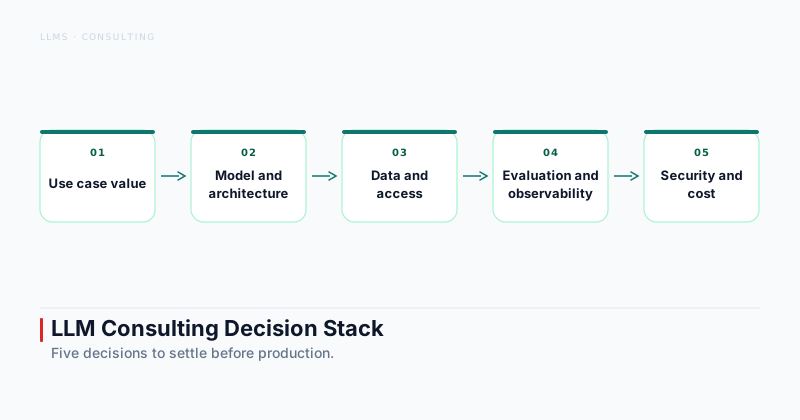
The sequence matters. Model choice is the easiest decision to change later, while data access patterns, identity design, and evaluation habits harden quickly. A consultant who opens with a model recommendation is answering the cheapest question first. The sections below follow the order in which mistakes become expensive: use case, architecture, data, benchmarking, operations, and finally the buyer checklist.
Ownership is the thread running through all of it. The engagement should leave your team holding decisions, test sets, and controls it can maintain without the original author in the room. If the plan only works while the consultant is present, you have bought a dependency rather than a capability.
Section 02 · Use Case
Start with the use case, not the model
Value and constraints come before any vendor name.
Map business value before model choice
Yogi Technolabs frames LLM strategy as an evaluation of the use case, the data, and the infrastructure before a model is selected, balancing capability, cost, latency, and data privacy. That ordering is worth borrowing. Write each candidate use case as a task with an owner, an input, an expected output, and a cost of being wrong. A support summarizer that is occasionally off by a sentence is a different risk class from an assistant that drafts contract language.
Rank use cases on two axes: the value of a correct answer and the damage of a wrong one. High value with low damage goes first, because it teaches your team how to operate these systems before the stakes rise. Ask the consultant to show this ranking in writing, with the assumptions behind each score.
Then write success down in numbers your finance partner would accept: tasks completed per week, minutes saved per task, error rate tolerated, and spend ceiling. A use case without a measurable target cannot be benchmarked later, and the engagement has no way to prove it worked.
Test data and infrastructure constraints early
A use case that depends on documents nobody can legally move, or on a system with no API, is blocked regardless of model quality. Have the consultant inventory where the data lives, who owns it, how fresh it must be, and what your current infrastructure can host. This inventory takes days, and it removes whole categories of proposals before anyone spends money on a prototype.
Section 03 · Architecture
Choose architecture by operational constraints
Where the model runs and who can reach it are architecture questions, not procurement details.
Hosted, private, and hybrid deployment choices
Hosted APIs, privately deployed models, and hybrid setups trade control against speed. Hosted access gets a prototype running quickly. Private deployment gives tighter control over data handling at the cost of operating the stack. Hybrid designs send sensitive requests to controlled infrastructure and everything else to hosted models. A consultant should lay out the tradeoff for your case instead of defaulting to whichever option their firm sells.
Deployment choice also interacts with spend and responsiveness. Once traffic grows, model routing and latency work decide whether the design stays affordable and fast, so ask for those assumptions up front rather than after launch.
Identity, access, and data residency
LLMConsulting.io describes enterprise architecture that includes SSO, role based access control, data residency, encryption, audit logging, and industry compliance requirements. Use that list as a checklist for any proposal. If a design review cannot say where prompts and outputs are stored, who can read them, and how long they persist, the architecture is unfinished. Security review will ask these questions eventually, and answering them early is cheaper than redesigning later.
Section 04 · Data Access
Ground models in business data safely
Retrieval makes a model useful and also makes it a new path to your data.
Retrieval and approved source access
LLM Consulting UK describes connecting models to company data and systems while respecting permissions, with private or controlled deployment options. The principle is simple to state and hard to build: the model should only see what the asking user is already allowed to see. Retrieval design determines which sources are approved, how they are indexed, and how stale content is handled, so ask to see that design before any build starts.
Decide early whether the use case needs retrieval, fine tuning, or both. Retrieval suits knowledge that changes and needs citations. Fine tuning suits stable behavior and output format. The RAG versus fine tuning decision guide walks through the tradeoff, and a consultant who recommends one without asking how often your data changes has not finished the analysis.
Permissions must follow existing business rules
Do not let the AI layer invent a second permission system. Document levels, team boundaries, and customer isolation already exist in your identity provider and source systems, and the retrieval layer should inherit them at query time. Ask the firm how a user who loses access to a document stops seeing it in answers, and how they would test that. A permission leak through a summary is still a leak.
Section 05 · Evaluation
Benchmark before major investment
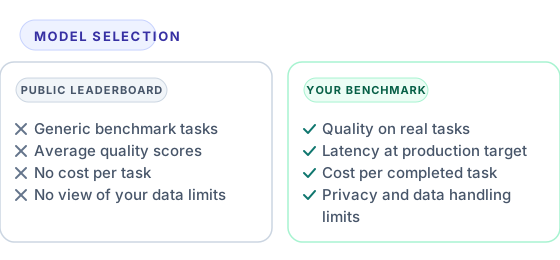
Public rankings describe general ability. Your decision depends on your tasks.
Use real tasks and real data
Yogi Technolabs describes benchmarking shortlisted models on real data and tasks before significant investment, then tracking accuracy, latency, cost, and safety in production. Build the test set from actual requests, including the messy and ambiguous ones, and have a domain expert label the expected outcomes. Keep the set small enough to review by hand and versioned so scores stay comparable. The consultant should hand it over as an asset you keep.
Compare quality, latency, cost, and safety
Score every candidate on all four dimensions together, because a model that wins on quality alone may miss your latency target or your budget. Set acceptance thresholds before the runs, not after. The figure below contrasts what a leaderboard tells you with what your own benchmark should tell you.
Cost needs unit economics, not a monthly estimate. Ask for cost per completed task at expected volume, then check the assumptions against the LLM pipeline cost calculator and the levers in LLM inference cost optimization. If the numbers only work at a volume you will not reach, it is better to learn that now.
Section 06 · Operations
Plan production operations from day one
A prototype that nobody can monitor is a demo, not a system.
Evaluation and monitoring
Maximum Labs presents LLM work as a path from roadmaps and prototypes to RAG, agents, evaluations, safety, and MLOps for production operation. The useful takeaway is that evaluation does not stop at launch. Reuse the benchmark set as a regression suite, and wire traces, quality scores, latency, and spend into dashboards your team reads. The LLM observability guide covers what to measure and how to wire it in.
Plan the failure paths as well. Agree what happens when the provider is slow or unavailable, when output fails validation, and when cost per task drifts above budget. Fallbacks, rollback steps, and spend alerts are cheap to specify during design and painful to invent during an incident.
MLOps, support, and team enablement
Ask who handles prompt and model version changes, who responds when quality drops, and how new team members learn the system. The engagement should include runbooks, documentation, and working sessions with the engineers who will own the service. Enablement is a deliverable with an acceptance test: can your team ship a prompt change and read a trace without outside help?
Section 07 · Buyer Checklist
A buyer checklist for LLM consulting proposals
Name the deliverables, then test for bias.
What deliverables should exist
A credible proposal names its outputs. Look for prioritized use cases, architecture decisions with reasons, model and vendor comparisons, data and access requirements, an evaluation plan, deployment controls, operating cost assumptions, and a roadmap to production. Each should be a document or artifact you can open, not a meeting. Missing items point to work you will pay for later.
| Deliverable | Acceptance test | Red flag |
|---|---|---|
| Use case ranking | Scores for value and cost of error, with stated assumptions | One recommended use case and no alternatives |
| Architecture decision record | Deployment, identity, and data residency choices with reasons | Defaults to a single vendor stack |
| Benchmark results | Your data, four dimensions, thresholds set in advance | Public leaderboard screenshots |
| Operations package | Monitoring, runbooks, and a documented handover | Support depends on the consultant staying |
How to detect vendor bias and lock in risk
LLMConsulting.io explicitly presents vendor neutrality as a design goal alongside model evaluation and monitoring, which is the standard to hold every firm to. Ask which platforms they resell, whether they earn referral fees, and what it would take to swap the model provider in your design. If the answer requires rewriting the application, the lock in is already in the architecture.
If you are weighing these decisions and want a senior architecture review before committing budget, the AI Systems Architecture service covers model selection, data access, and evaluation design as one engagement.